The September Equinox
There are two equinoxes every year: one in September and one in March. In September, the Sun crosses the equator from north to south.
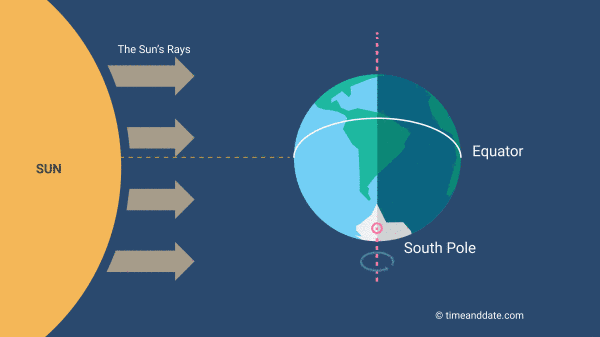
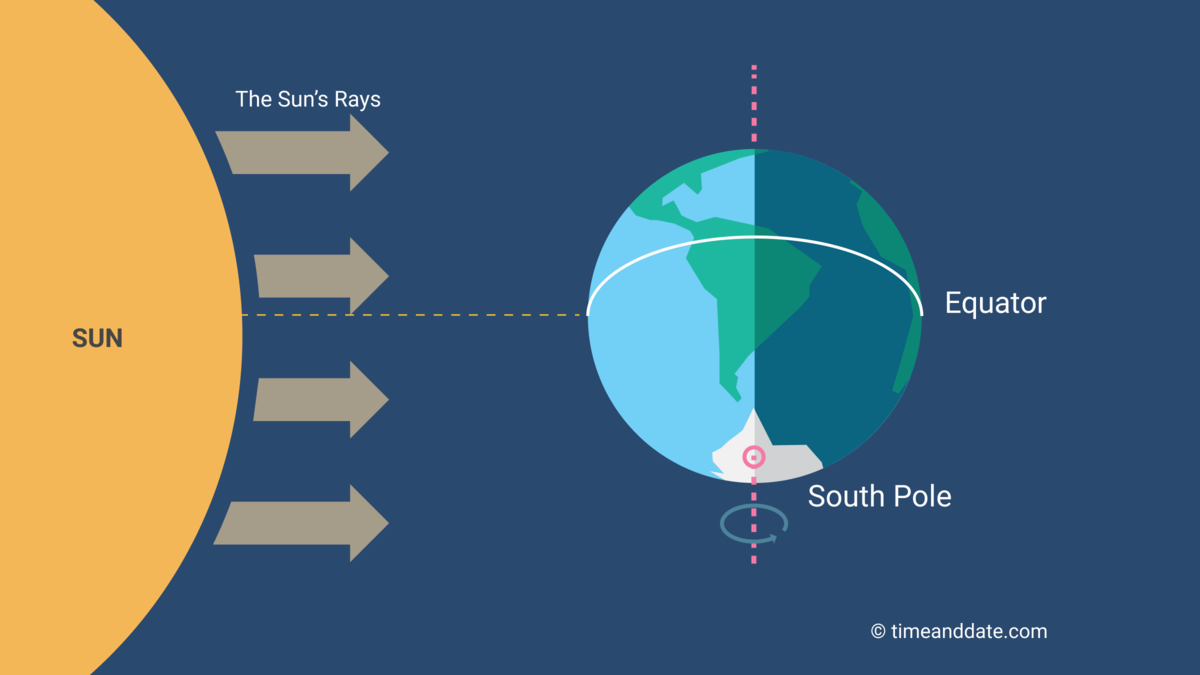
At the equinox, Earth’s axis is perpendicular to the Sun’s rays as the Sun is directly above the equator.
timeanddate.com
Sun Crosses Celestial Equator
The September equinox is the moment the Sun crosses the celestial equator—an imaginary line in the sky above Earth’s equator—from north to south. This happens on September 22, 23, or 24 in most years.
10 facts about the September equinox
Equinox Local Time & Date
In Columbus, Ohio, USA: Sunday, September 22, 2024 at 8:43 am EDT (Change location)
This corresponds to Sunday, September 22, 2024 at 12:43 UTC.
Why Does the Sun Move North and South?
During the course of a year, the subsolar point—the spot on the Earth's surface directly beneath the Sun—slowly moves along a north-south axis. Having reached its northernmost point at the June solstice, it starts moving southward until it crosses the equator on the day of the September equinox. The December solstice marks the southernmost point of its journey.
The subsolar point moves north and south during the year because the Earth’s axis is tilted at an angle of about 23.4° in relation to the ecliptic, an imaginary plane created by Earth’s path around the Sun. In June, the Northern Hemisphere is tilted toward the Sun, and the subsolar point is north of the equator. As the Earth travels toward the opposite side of its orbit, which it reaches in December, the Southern Hemisphere gradually receives more sunlight, and the subsolar point travels south.
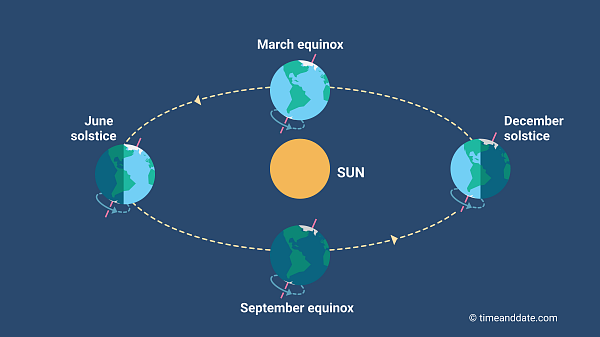
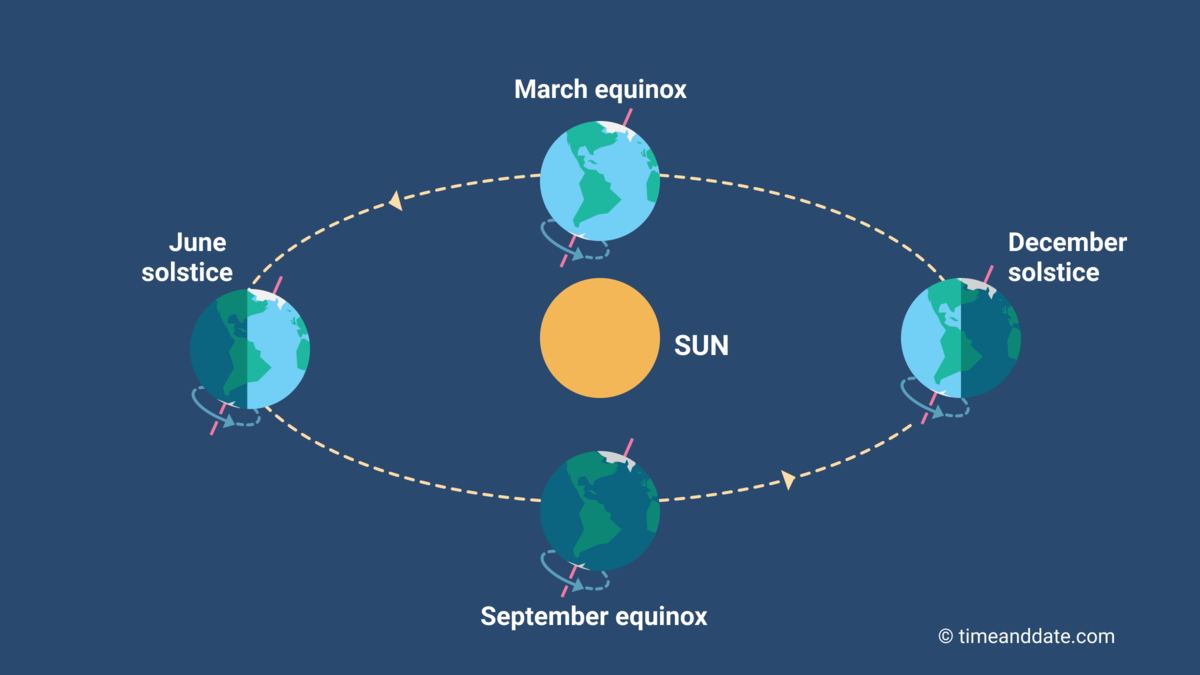
Earth is tilted as it orbits the Sun, which is why equinoxes and solstices happen.
©timeanddate.com
Why Is It Called “Equinox?”
On the days of the equinoxes, the Earth’s axis is perpendicular to the Sun’s rays, meaning that all regions on Earth receive about the same number of hours of sunlight. In other words, night and day are, in principle, the same length all over the world. This is the reason it’s called an “equinox,” derived from Latin, meaning “equal night.”
However, this is literal translation not entirely true. In reality, equinox days don’t have exactly 12 hours of daylight and 12 hours of dark.
Equilux: when day and night are (actually) equal
Astronomical terms & definitions
The Equinoxes and the Seasons
The March and September equinoxes mark the beginning of the spring and autumn seasons on Earth, according to one definition. The equinox in September is the start of fall in the Northern Hemisphere and the beginning of spring south of the equator.
Equinox and solstice dates—years 1-2149
Why Does the Date Vary?
The date of the equinoxes and solstices varies because a year in our calendar does not exactly match the length of the tropical year—the time it takes the Earth to complete an orbit around the Sun.
Today's Gregorian calendar has 365 days in a common year and 366 days in a leap year. However, our planet takes about 365.242199 days to orbit the Sun. This means that the timing of the equinoxes and solstices slowly drifts apart from the Gregorian calendar, and the solstice happens about 6 hours later each year. Eventually, the accumulated lag becomes so large that it falls on the following date.
To realign the calendar with the tropical year, a leap day is introduced (nearly) every four years. When this happens, the equinox and solstice dates shift back to the earlier date again.
Other factors influencing the timing of the equinoxes and solstices include variations in the length of a tropical year and in the orbital and daily rotational motion of the Earth, such as the “wobble” in the Earth's axis (precession).